Ok, let’s start with the negatives, shall we? The arguments for not needing music braille.
Lots of the students that I encounter are great at learning music by ear. They learn quickly and can learn very complex music using aural methods, especially if their teacher makes recordings for them to use in between lessons. The music has to be memorised anyway, so why does it matter how the music is learned?
With music technology it’s possible to share scores and interact with software such as Sibelius or Musescore with speech software.
So, why bother?
Below is a picture of a page of braille music.
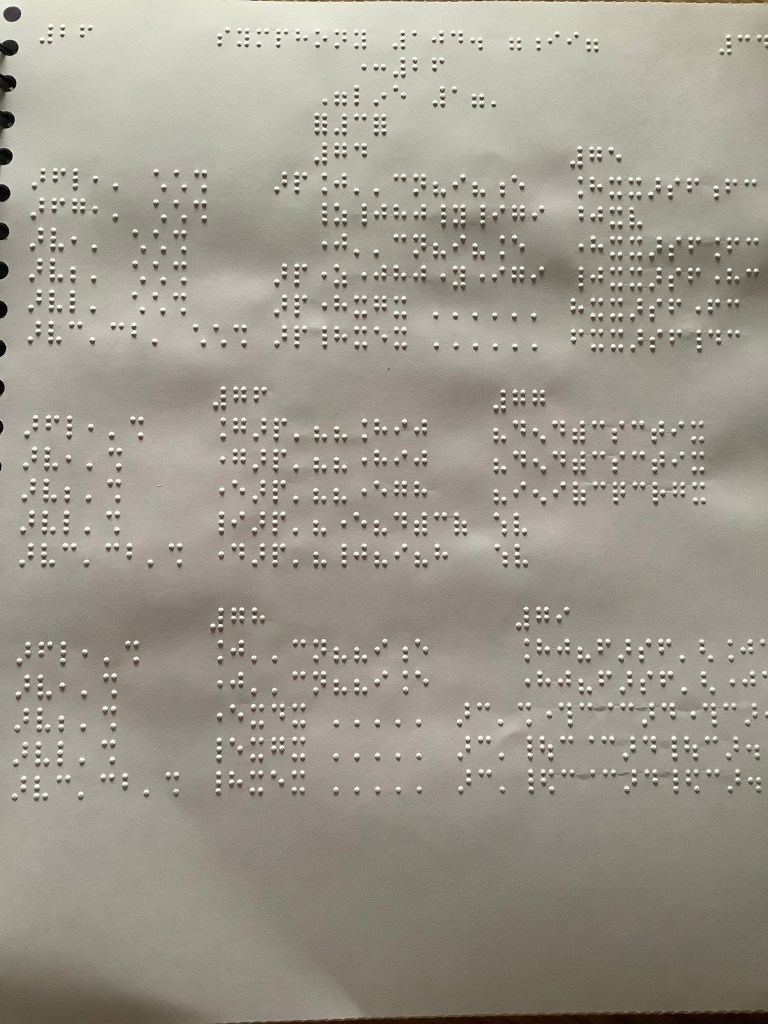
Braille music is difficult to get hold of. It can take a long time to transcribe, it’s so labour intensive and getting something transcribed is really expensive – I mean REALLY expensive! It’s big and bulky. Just one of the A level set works my students are currently studying is in seven volumes. There’s relatively little notation in the gcse so it’s easy to think it’s not worth the bother, after all, it’s so difficult to find someone who can teach it. Past papers are difficult to get hold of and most music braille teaching resources don’t even mention the signs typically needed for a skeleton score question. When you consider all these negatives it’s easy to understand why braille music is a bit niche. At the recent International Conference for English Braille (ICEB) event hosted in London last year there was lots of discussion in the music braille group about the lack of suitable teaching resources and a genuine fear that there is not enough braille music teaching going on. We are in danger of valuable expertise being lost as teachers retire and not enough newbies embracing this coming through. So, should we be bothered?
Well, yes!
Would we say to a child, it’s ok, you don’t need to learn how to read? You can have someone read it to you. It doesn’t matter if they don’t say it correctly, it’s close enough. You can place your trust in someone else. You’ll have to rely on them, but hey! There are lots of audio books and you can always get computer speech software.
I don’t think so. It’s all about being literate. When a composer writes down his or her ideas using notation it is a direct link from the musical thoughts and intentions in their head to the signs and symbols on the page in exactly the same way that a writer’s thoughts are represented by words. When we read the words on the page we hear the sounds of the words in our head with our interpretation – our pace, our rhythms and our pronunciation. When we read musical notation it is the same process. We interpret the signs creating not only the notes themselves but the phrasing, dynamics and articulation – all of which are shown in the notation. If we deny our students access to this then we deny them the freedom to interpret music directly from the composer’s intentions.
I do come across braille refusers and there may be a loss of sensitivity in the fingers and other legitimate reasons why braille is challenging for someone. However, as a point of principle, if you have a competent braillist taking up music then braille music really ought to be an option.
It all boils down to independence. Teaching our students to be independent takes time and effort but to my mind, we have to give students that option. The ability to read music will create so many more opportunities, whether it is academic study, joining the local choir, performing in groups, teaching others or just simply the joy of choosing a piece to learn and working it out for yourself. You can’t really put a price on that.
 VI Music Education